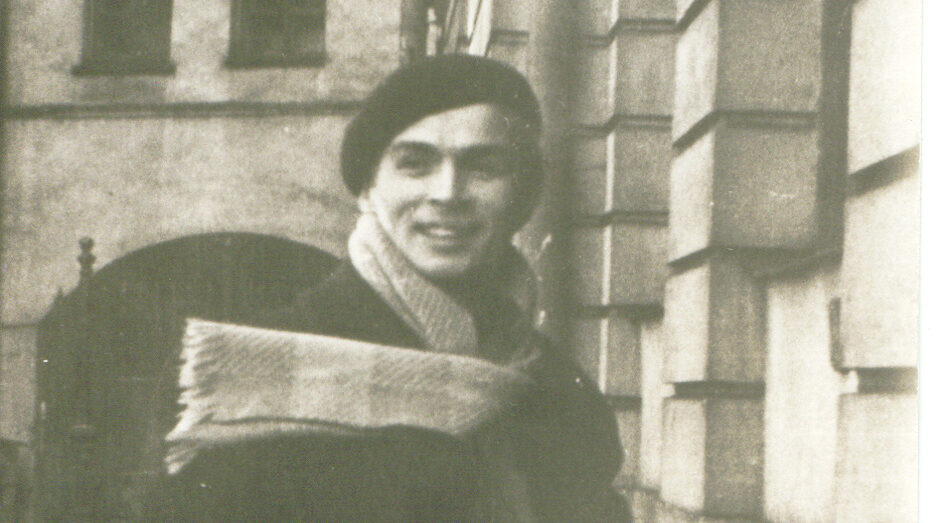
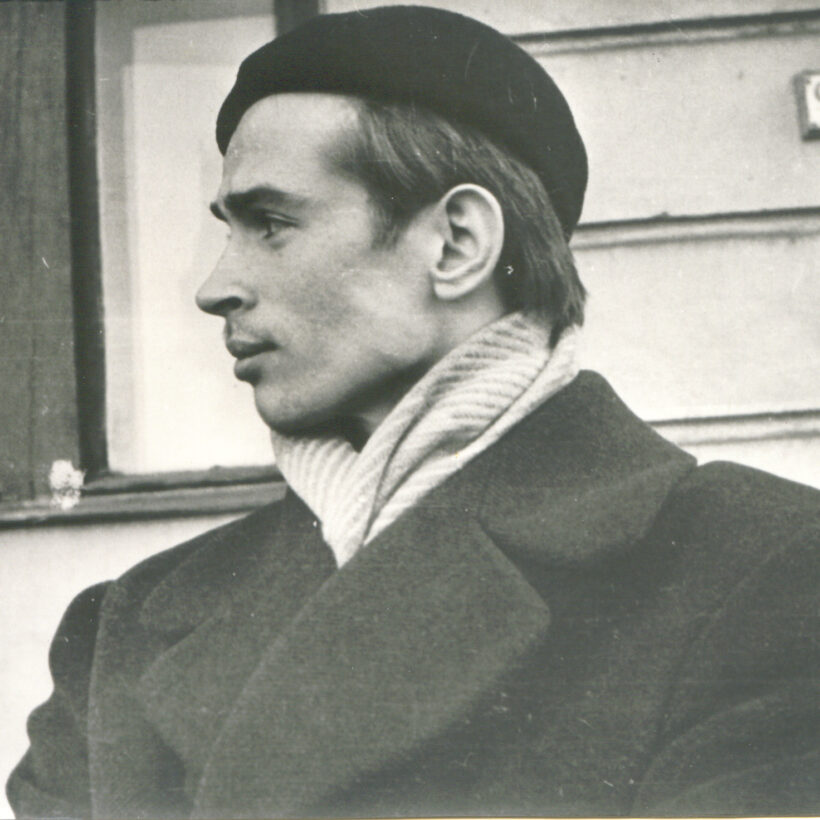
From his birth on the Trans-Siberian express train in 1938, to his untimely death just 54 years later, Rudolf Nureyev lived a unique life. This timeline highlights some of the landmark moments in his extraordinary journey.
To find out more about Rudolf Nureyev’s life, career and legacy, see Julie Kavanagh’s articles on his Impact & Influence, or explore The Nureyev Database – a searchable catalogue of Nureyev’s work as performer, choreographer, producer and conductor.
17 March: Rudolf Khametovich Nureyev, fourth child and only son of Hamet and Farida, is born on the Trans-Siberian Express train, near Lake Baikal.
Nureyev’s early years are spent in Ufa, capital of the Soviet Republic of Bashkir, living in extreme poverty. He later describes this time as his ‘potato period’, remembering constant hunger and the shame of being called bomsch (beggar) because he has no shoes. There are no toys or games at home, but the family does own a tiny radio. The Soviet policy of broadcasting the great 19th century composers when a person of importance dies launches his life-long love of music.
His father is a Red Army political commissar. Hamet’s long absences from home mean Nureyev develops a close relationship with his mother and sisters. He is nearly eight years old when he first sees his father, who tries in vain to make a Tatar man of him.
Nureyev’s first dance steps are in the regional folk dances taught at kindergarten, where his spirit and energy immediately mark him out. At School Number Two (now known as the Rudolf Nureyev Ballet School) his potential is spotted by a soloist from Ufa Theatre who introduces Nureyev to Anna Ivanova Udeltsova – ‘almost a real ballet teacher’ – he later said. His twice weekly classes take place in secret, against his father’s wishes.
Aged 15, Nureyev begins to serve as an ‘extra’ in productions at the Ufa Opera House. He is offered a contract but uses his earnings to pay for a train ticket to Leningrad: his ambition is to join the school of the Kirov Ballet.
25 August: Nureyev auditions for the Kirov’s Vaganova Academy and is accepted. He enters the school on 7 September, and before long successfully argues to be allowed to study under the great Alexander Pushkin. At 17, he lacks the skills of his fellow students but works intensively to catch up – and to overtake them.
Nureyev’s rebellious spirit is already evident. He defies rules by sneaking out at night to concerts, plays and ballets, winning the admiration of his dormitory mates.
Nureyev dances the pas de deux from Le Corsaire with Alla Sizova at the Moscow Competition and for his graduation performance.
On graduating, the Ufa Ballet demands his return, in repayment of the monies the Republic of Bashkir had paid for his training. Nureyev heads to the Ministry of Culture in Moscow to argue his case but is told the decision is made. Back in Leningrad, he hears that Pushkin has successfully petitioned on his behalf. Nureyev will not only be joining the company as a soloist – he will make his debut with the company’s most senior ballerina.
20 November: Nureyev makes his Kirov debut dancing Laurencia, with Natalia Dudinskaya.
26 July – 4 August: Nureyev gives his first performances outside the USSR, performing Le Corsaire with Alla Sizova at the Vienna International Festival of Youth. Their performance receives the highest marks.
Back at the Kirov, Nureyev makes his debuts in Swan Lake, La Bayadère and Giselle, building a base of ecstatic fans.
He continues to cement his reputation as a non-conformist, challenging the long traditions of the Kirov and refusing to sign up to party membership.
The decade closes with Nureyev taking part in another official Kirov tour outside the USSR, to Cairo and Beirut.
Nureyev’s Leningrad fame continues to grow, with performances in The Nutcracker, Swan Lake and The Sleeping Beauty.
27 May: His debut in Don Quixote adds to Nureyev’s notoriety, when a dispute over his costume delays the curtain by an hour.
June: Nureyev is invited to dance for Nikita Kruschev at Nikolai Bulganin’s villa outside Moscow.
May: Despite serious concerns about Nureyev’s conduct and his loyalty to the USSR, Nureyev is included in the list of dancers who will join the Kirov Ballet tour to Paris and London. The Paris season opens at the Palais Garnier on 16 May 1961.
19 May: Nureyev’s performance as Solor in the Kingdom of the Shades scene from La Bayadère causes a sensation. It is the first of a number of Paris performances over the following month.
16 June: Nureyev requests political asylum at Le Bourget Airport.
Over the next few months, Nureyev dances with the Marquis de Cuevas company in The Sleeping Beauty, in Paris and on tour.
He also travels to Copenhagen, where he meets and studies with Erik Bruhn. A love affair begins that continues, on and off, to the end of the decade.
August: Nureyev makes his first television appearance in the West, dancing the pas de deux from Giselle Act II with Irène Skorik for German TV.
2 November: Nureyev dances for the first time in London. The guest of Margot Fonteyn, he performs a newly created piece by Frederick Ashton – Poème tragique – at a charity gala for the Royal Academy of Dance.
10 January: Nureyev appears on the BBC for the first time, dancing the pas de deux from The Nutcracker with Rosella Hightower.
19 January: Nureyev appears for the first time on US television, faultlessly dancing Bournonville’s Flower Festival at Genzanowith Maria Tallchief on the Bell Telephone Hour.
21 February: Nureyev dances Giselle at the Royal Opera House in London with Margot Fonteyn. He is 23, she is 42. They receive 23 curtain calls.
10 March: Nureyev appears live in the US for the first time, at the Brooklyn Academy of Music, dancing the pas de deux from Don Quixote with Sonia Arova. Among the celebrity audience is George Balanchine, the choreographer Nureyev most admires. Nureyev yearns to dance with his company, New York City Ballet, but Balanchine is convinced that his star status would be destabilizing. He advises Nureyev, ‘when you are tired of playing at being a prince, come to me’.
2 April: The trial of Rudolf Nureyev – ‘traitor number 50,888’ – takes place in absentia and behind closed doors in Leningrad. He is convicted under article N64 but does not receive the death penalty. His sentence is seven years’ imprisonment.
Nureyev is invited to join The Royal Ballet as guest artist, a role he retains until 1977.
5 July: Fonteyn and Nureyev dance Swan Lake together at the Nervi Festival.
3 November: Rudolf Nureyev’s Autobiography with Pictures is published.
22 January: Nureyev makes his first appearance in a modern ballet role, dancing John Cranko’s Antigone with The Royal Ballet.
12 March: Premiere of Marguerite and Armand, created for Fonteyn and Nureyev by Frederick Ashton. It becomes their signature ballet.
25 April: Nureyev dances Giselle at the Metropolitan Opera House in New York.
Nureyev buys his first property, Villa Arcadie, in the South of France. Some of the art and artefacts from his homes can be seen at the Centre national du costume et de la scène.
27 November: Nureyev mounts his first staging for The Royal Ballet, Act III of La Bayadère, known as Kingdom of the Shades.
9 February: Nureyev stages the Laurencia pas de six for a British television programme, The Golden Hour.
2 April: Nureyev makes two debuts with The Royal Ballet in one evening: Images of Love (MacMillan) and Hamlet (Helpmann).
July: Nureyev mounts the full-length Raymonda, never before seen in the west, in Spoleto.
October: Nureyev stages his production of Swan Lake in Vienna, dancing with Fonteyn. They receive 89 curtain calls on the first night.
Nureyev’s travels around the world as a guest artist in 1964 include a two-month tour of Australia, with Fonteyn.
9 February: Fonteyn and Nureyev dance Kenneth MacMillan’s Romeo and Juliet with The Royal Ballet. They receive 43 curtain calls. The ballet was created for Lynn Seymour and Christopher Gable, but the box office draw of the Fonteyn/Nureyev partnership means they are given the first performances in London and on the New York tour.
16 May: Fonteyn and Nureyev’s fame continues to extend beyond the ballet world. They dance Swan Lake on the Ed Sullivan show in the US.
18 May: Nureyev creates his first original ballet, Tancredi, for the Vienna State Ballet.
22 September: Nureyev mounts his own production of The Sleeping Beauty at La Scala, Milan.
1 December: Nureyev creates his own version of Don Quixote for the ballet company in Vienna.
23 February: Fonteyn and Nureyev create the leading roles in Paradise Lost, by Roland Petit, in London with The Royal Ballet.
The Royal Ballet’s summer tour to the US opens in New York in May 1967. ‘Rudi mania’ is in full flow, with audiences queuing through the night to buy tickets. Illegal photos of performances change hands on the black market. One fan films Nureyev’s performances from high up in the auditorium of the Met. The Lucia Wayne Collection of 8mm films is now held in the Jerome Robbins Dance Collection at the New York Public Library.
12 July: Fonteyn and Nureyev are arrested in San Francisco when a party they attend is raided by the police. They are later released without charge.
In November, Nureyev purchases his first London property, 6 Fife Road, known as The Farm. Some of the art and artefacts from his homes can be seen at the Centre national du costume et de la scène.
17 November: Nureyev creates his own version of The Nutcracker for The Royal Swedish Ballet in Stockholm.
9 January: Nureyev and Antoinette Sibley create the roles of ‘Friday’ in Frederick Ashton’s Jazz Calendar, with The Royal Ballet in London.
25 February: Nureyev’s father dies.
29 February: Nureyev’s Nutcracker has its premiere at The Royal Ballet in London.
25 December: Nureyev dances his first contemporary role, Rudi Van Dantzig’s Monument for a Dead Boy with Dutch National Ballet.
June: Nureyev meets Wallace Potts, a student, while on tour with The Royal Ballet in the US. They begin a relationship that lasts over seven years. Potts would go on to become a film maker and, as film archivist, to compile the Rudolf Nureyev Film Collection, housed at the New York Public Library.
2 March: Opening night of Rudi Van Dantzig’s Ropes of Time, the first commission to be created entirely as a showcase for Nureyev.
20 March: Alexander Pushkin, Nureyev’s mentor and teacher, dies.
July: Nureyev meets Mikhail Baryshnikov, another protégé of his teacher, Pushkin, while the Kirov is on tour in London.
4 September: Natalia Makarova, prima ballerina with the Kirov Ballet, defects while on tour with the company in London.
19 October: The opening night of Jerome Robbins’ Dances at a Gathering, for The Royal Ballet, as part of an ensemble that includes principal dancers Anthony Dowell, Antoinette Sibley and Lynn Seymour.
Nureyev’s 1970 touring schedule includes London, Marseille and Berlin, as well as a rehearsal period in Australia.
In early 1971, Nureyev guests with the Australian Ballet, dancing 68 of the company’s 70 performances on their American tour.
11 March: Nureyev performs with Béjart’s Ballet of the 20th Century in Brussels to an arena audience of 5000.
14 March: Nureyev appears on American TV in a CBS special – A Bacharach Potpourri – dancing Paul Taylor’s Big Bertha.
The year concludes with performances with The Royal Ballet and a further version of Raymonda, which Nureyev stages for the ballet company in Zurich.
Nureyev’s schedule includes performances with The Royal Ballet in London and Paul Taylor Dance Company on a tour to Mexico City.
1 September: First performance of Nureyev’s The Sleeping Beauty for the National Ballet of Canada, in Ottawa.
13 November: Nureyev directs a film of his Don Quixote with The Australian Ballet. The filming takes place on a specially constructed set in a disused aircraft hangar outside Essendon, near Melbourne. Nureyev stars alongside Lucette Aldous, with Robert Helpmann as Don Quixote.
Nureyev tours the US with the National Ballet of Canada, dancing alongside Karen Kain in his production of The Sleeping Beauty, helping to establish her as an international star.
July: Nureyev dances with Natalia Makarova for the first time since her defection to the West. They perform Romeo and Juliet with The Royal Ballet in London and Swan Lake with the Paris Opéra Ballet.
Nureyev’s performance schedule includes Canada with the National Ballet of Canada, New York with The Royal Ballet and Paris with the Paris Opéra Ballet.
29 June: Mikhail Baryshnikov, the third of three great dancers to defect from the Soviet Union, requests political asylum in Canada.
June: Nureyev presents the first of many Nureyev & Friends programmes, in which he invites a small number of leading dancers to join him in a mixed gala programme. The first of this long running series takes place at the Palais des Sports in Paris.
Nureyev continues to perform with ballet companies around the world, including with The National Ballet of Canada on their tour to London.
19 June: Fonteyn and Nureyev dance with the Martha Graham Dance Company in New York, in Lucifer.
19 September: The first night of a season in which Nureyev dances with Scottish Ballet on a tour to Madrid. He makes two debuts: Moments by Murray Louis and The Lesson, by Flemming Flindt.
18 November: Nureyev ends the year in New York, dancing a Fonteyn & Nureyev programme and several performances with the Martha Graham Dance Company.
1 June – 17 July: The first of the annual Nureyev Festivals, in which Nureyev dances at every performance. Annual festivals (of two to seven weeks) will run until 1985 and include 33 different companies.
December: Natalia Makarova and Rudolf Nureyev dance Swan Lake with The Royal Ballet in London.
Nureyev’s 1976 guest performance schedule includes New York with the National Ballet of Canada and Copenhagen with the Royal Danish Ballet.
April: Nureyev creates his own version of Romeo and Juliet for London Festival Ballet, dancing alongside Patricia Ruanne.
May: Nureyev appears before the Washington Congress in his bid to have the Soviet Authorities allow his family to visit him in the West.
July: Rudolf stars in the film Valentino.
4 – 9 July: Nureyev and Fonteyn dance Marguerite and Armand together for the last time.
22 January: Nureyev appears on The Muppet Show, dancing with Miss Piggy.
April: A New York season of Nureyev & Friends includes new modern works by Toer Van Schayk, Murray Louis and Rudi Van Dantzig.
14 September: Nureyev dances the leading role of Basilio in Mikhail Baryshnikov’s production of Don Quixote with American Ballet Theater.
Nureyev buys an apartment in New York’s Dakota Building. Some of the art and artefacts from his homes can be seen at the Centre national du costume et de la scène.
Nureyev’s touring schedule includes performances with Dutch National Ballet and London Festival Ballet.
1 March: Nureyev dances in a Homage to Diaghilev with the Joffrey Ballet in New York.
8 April: Nureyev dances with New York City Ballet in Le Bourgeois Gentilhomme by George Balanchine. This would be the only time this renowned choreographer would make a work on him.
20 November: Nureyev creates another original ballet – Manfred – which has its premiere at the Palais des Sports. An injury prevents him from dancing, so Jean Guizerix takes the title role.
Nureyev’s extensive touring schedule continues, with guest appearances with the Zurich Opera Ballet, Vienna State Ballet, Boston Ballet, Martha Graham Dance Company and the Berlin Ballet.
15 October: Nureyev’s production of The Sleeping Beauty opens at the Vienna Opera House, with Gisela Cech and Nureyev in the leading roles.
20 December: Nureyev’s Romeo and Juliet premieres at La Scala, Milan, with Carla Fracci dancing alongside him in the title roles.
March: Nureyev buys an apartment overlooking the Seine and the Palais du Louvre, on the Quai Voltaire in Paris. Some of the art and artefacts from his homes can be seen at the Centre national du costume et de la scène.
July: Nureyev invites Margot Fonteyn to appear as Lady Capulet in the La Scala performances of Romeo and Juliet on tour in New York.
Performances this year include guest engagements with Rome Opera Ballet, Cullberg Ballet in Sweden and the Paul Taylor Dance Company in New York.
February: After five years’ absence, Nureyev is invited to give a series of performances with The Royal Ballet. His return is celebrated in a BBC Omnibus programme.
Nureyev’s determination to continue performing rules him out of consideration for the role of Director of The Royal Ballet. Negotiations open in Paris, where the search for a new director of the Paris Opéra Ballet is underway.
2 December: The gala opening of Nureyev’s ballet, The Tempest, with Anthony Dowell in the leading role of Prospero. Nureyev dances the role the following evening.
Nureyev buys a farm in Virginia, US.
Nureyev stars alongside Nastassja Kinski and Harvey Keitel in James Toback’s film, Exposed.
September: Nureyev is appointed director of the Paris Opéra Ballet by Culture Minister, Jack Lang.
5 November: Nureyev’s inaugural production with the Paris Opéra Ballet, a new staging of his Raymonda, opens at the Palais Garnier.
Nureyev launches a programme of contemporary choreographers at the Paris Opéra, with work by Merce Cunningham, Louis Falco and William Forsythe.
Later seasons would include work by Martha Graham, Rudi Van Dantzig, Michael Clark, Carolyn Carlson, Lucinda Childs, Paul Taylor, Maurice Béjart, Twyla Tharp, Robert Wilson, Jiri Kylian, John Neumeier, Alvin Nikolais, Maguy Marin and Philippe Decoufle.
Nureyev is diagnosed with AIDS.
23 January: First performance by the Paris Opéra of Martha Graham’s Phaedra’s Dream.
16 April: Nureyev co-creates Bach Suite, with Francine Lancelot, drawing on the traditions of baroque dance.
20 December: Nureyev produces a new version of Swan Lake for the Paris Opéra Ballet.
22 December: Sylvie Guillem, one of the young dancers Nureyev nurtures, is promoted to premiere dancer. One week later, after her performance in Swan Lake, Nureyev names her as étoile, the highest rank at the Paris Opéra.
6 June: The opening night of Nureyev’s Washington Square, created for the Paris Opéra and based on the novel by Henry James.
June-July: Nureyev performs in Edinburgh, Manchester, London and on a tour of Italy.
September – October: Nureyev travels to China and Japan to stage his Don Quixote.
November: Nureyev’s touring continues, to Italy and Germany, with the Nancy Ballet. His doctor travels with him.
Nureyev replaces his house in the South of France with an apartment in Monaco.
March: Maurice Béjart’s Arepo opens at the Paris Opéra. Onstage after the performance, Béjart promotes the two leading dancers, Eric Vu An and Manuel Legris to the rank of étoile – an unprecedented breach of protocol. Only the director – Nureyev – had the right to promote dancers. A public scandal follows, playing out on television and in press around the world. Despite multiple threats of resignation, Nureyev stays in position.
1 April: Erik Bruhn dies.
24 October: Nureyev creates an original Cinderella, in which the action is relocated to Hollywood.
Despite his progressing illness, Nureyev is determined to dance as often as possible, including performances with Northern Ballet Theatre, London Festival Ballet, Ballet du Louvre and Nancy Ballet.
8 May: At Baryshnikov’s invitation, Nureyev dances Giselle with American Ballet Theatre in New York.
14 November: The Soviet authorities grant permission for Nureyev to visit his sick mother, in Ufa. His permit allows entry for two days.
February: Nureyev hears that his mother has died.
Nureyev’s 50th birthday year is marked by a gala in New York and, in London, a 7 January performance of Giselle in which he dances with Sylvie Guillem and The Royal Ballet.
June: Nureyev makes his debut with New York City Ballet in Orpheus.
Nureyev buys the island of Li Galli, off the cost of Italy. The island was owned previously by the dancer and choreographer Leonid Massine.
Nureyev’s determination to continue to tour alongside his directing obligations puts him into dispute with the Paris Opéra.
Nureyev signs a contract to perform the musical The King and I on Broadway and on tour.
6 November: Nureyev returns to Russia to dance in La Sylphide at the Kirov Theatre in Leningrad, where he had made his professional debut 18 years earlier. He was also able to reconnect with his first dance teacher (by then, aged 100).
10 January: Nureyev announces his decision to leave the Paris Opéra.
11 February: The King and I closes early, with its final performance in San Francisco.
Spring: Nureyev undertakes a Farewell Tour, playing to smaller theatres across the UK.
30 May: Nureyev dances Mercutio in a special Royal Ballet performance of Romeo and Juliet to honour Margot Fonteyn.
April: Nureyev buys a seafront house on the Caribbean island of St Barthélemy. Some of the art and artefacts from his homes can be seen at the Centre national du costume et de la scène.
21 February: Fonteyn dies. It is the anniversary of their first performance of Giselle.
3 May: Nureyev dances his final performance in London at the Wembley Conference Centre.
25 June: With his health in serious decline and dancing ever more difficult, Nureyev takes up conducting. He makes his debut directing the Wiener Residenz player in a mixed programme at the Palais Auersperg.
1 March: Nureyev dances his last performance, as the Angel in Cristoforo in Budapest.
March: Nureyev travels to Russia to conduct a performance of Romeo and Juliet at the Kazan Opera and of Schéhérazadein Leningrad. He returns to Paris with a raging fever and is admitted to hospital, for an operation on his heart.
14 April: Nureyev draws up his will.
6 May: Nureyev conducts a performance of Romeo and Juliet with American Ballet Theater at the Metropolitan Opera House in New York. The principal roles are danced by his Paris Opéra protégés, Sylvie Guillem and Laurent Hilaire.
June-July: Nureyev conducts performances of Rossini and Mozart in Vienna. He gives his final performance, as conductor of an orchestra of University of California students in San Francisco, in July.
July: Nureyev returns to Paris to work on La Bayadère at the Paris Opéra.
August: Nureyev visits his island, Li Galli, for the last time.
8 October: La Bayadère, Nureyev’s final production, premieres at the Paris Opéra. Nureyev watches from a couch in a box near the stage and is supported on to the stage to take a bow. Culture Minister Jack Lang honours him with the title Commander of Arts and Letters.
October: Nureyev travels to his house on the island of St Barthélemy for the last time.
December: Nureyev is admitted to Notre Dame du Perpétual Secours hospital in Paris.
6 January: Nureyev dies.
12 January: A civil ceremony is followed by a remembrance event at the Palais Garnier at which Nureyev is posthumously awarded the Order of the Legion d’honneur, the highest decoration the French bestow.
He is buried at the Russian Cemetery in Saint-Geneviève-des-Bois, outside Paris.