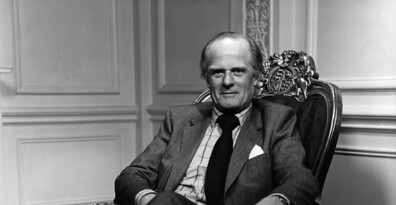
Sir John Tooley (1924-2018) was General Director of London’s Royal Opera House and the chair of the Rudolf Nureyev Foundation between 1995 and 2008.
Sir John Tooley writes about working with Rudolf Nureyev and the ways in which he changed ballet in the West.
“His impact means that classical ballet will never be the same again.”
John Tooley
1961 was eventful and significant in the post war history of the Royal Opera House and its two principal companies, The Royal Opera and The Royal Ballet. That year saw the arrival of George Solti as Music Director of the Opera and the defection in Paris of Rudolf Nureyev. Later that year, Nureyev appeared in London in a charity performance organised by Margot Fonteyn. This in turn led to an invitation from Dame Ninette de Valois to join The Royal Ballet as a guest artist.
Suddenly in our midst were two charismatic artists, with strong personalities and boundless energy, hell bent on success for themselves and for those with whom they worked. At the beginning Solti announced to the world that he was going to make The Royal Opera the greatest company in the world, a sentiment which I am sure Rudolf would have shared if he had been in such a position, in charge of a ballet company at the time. Their effect was of a meteor hitting Covent Garden.
Prior to Rudolf’s decision to remain in Paris in June 1961, as the Kirov Ballet left for London, reports had been circulating about the quality and virtuosity of Rudolf’s dancing in Leningrad. When the company started to perform in Paris, immediately before their London season, the reporting became intensified, now firsthand and gaining in credibility. Expectations of an astonishing revelation in male dancing ran high, only to be dashed by his failure to arrive in London with the company.
I was at Heathrow that day, 16 June, waiting to greet the company. There were already rumours of an incident around a dancer at Le Bourget, but no more than that, and no light was shed on who it might be. This situation was little changed on the company’s arrival, as the Soviet practice of total secrecy prevailed. No-one was willing to talk, except for Constantin Sergeyev, the artistic director, and Natasha Dudinskaya, his wife and ballerina. They told me that I should listen only to them and shortly the truth would be revealed. The company was in state of shock and some were in tears. Rudolf had little opportunity to tell anyone why he was not coming to London. In any event, he did not believe the reason he was given by Sergeyev for being returned to Moscow and concluded that this was the end for him as a serious dancer either with the Kirov or the Bolshoi. More likely, he thought, he would be sent to the small company in his birthplace, Ufa, unless he made a dash for freedom. That moment was seized.
For Rudolf, nothing had come easily. His childhood was harsh and deprived, with little money, food or clothing. There was in him, however, a dream world in which he inhabited the theatre and dance: it was this that drove him and continued to drive him all his life. As he often said, the stage is my home. His father, a professional soldier and a communist party member and commissar, was far removed from such a life. He was angry and threatening when he discovered that Rudolf was attending ballet class, a fact that Rudolf had tried to conceal from him. Undeterred by this hostility, Rudolf continued his ballet tuition, intent on gaining entry to the Vaganova School in St Petersburg. Late starter though he was, he was still successful in being admitted and eventually came under the influence of a great teacher, Alexander Pushkin. Pushkin befriended him, having detected a rare talent in a raw and undisciplined frame, and accepted the challenge to help Rudolf to become a successful and fulfilled artist.
Rudolf responded wholeheartedly to Pushkin’s encouragement and to the demands made on him. Rudolf worked and worked on his technique, something he was to do for the rest of his life, never content with where he was. This work was part of what he brought to the West. He knew that there are no short cuts to success and there is no substitute for work, however talented you are.
His graduation performance was a conspicuous success and was followed by an invitation from the Bolshoi. This was not what Rudolf wanted, and he strove to join the Kirov Ballet which he successfully achieved, winning the attention of Natalia Dudinskaya. She asked him to dance with her, as he was to do, along with other leading ballerinas of the company.
Rudolf revelled in his work and in being a member of one of the world’s greatest ballet companies. However, he saw it as a confined world with no contact with artistic developments in the rest of the world. The repertoire was narrow and restricted to the work of Soviet choreographers. There was also the dead hand of Constantin Sergeyev, the artistic director, a fine former dancer but with a limited vision for his company. Rudolf was to have direct experience of this when it came to the opening performance of The Sleeping Beauty in Paris, a performance in which he assumed he would be appearing. This was not to be so: the premiere went to Kopolkova and Semenov, who were received with moderate enthusiasm. How much of Sergeyev’s decision was due to jealousy and to an awareness that evening might well go to Nureyev rather than the company, one cannot know. Dudinskaya was to say later that Rudolf stunned the audience when he did appear – in the fourth performance – and that he was a showstopper.
Rudolf fell immediately in love with Paris and, contrary to all Soviet directions, wandered freely around the city, talked in faltering English and visiting museums and galleries. Probably worst of all (from the Soviet viewpoint) he also visited private houses, but it was all anathema to the Russian authorities. There were strict rules for those on tour, enforced by the Kirov’s assistant director, a KGB representative. Commissars were placed in the company and company dancers who were paid up party members spied on fellow dancers, reporting transgression to their superiors. It was a horrible regime, which I saw at work at close quarters during visits by Russian companies to London. Nureyev was not to be deterred and eventually paid the price for the errors of his ways by being denied the London visit.
What thought he had given to defection before the event, I do not know. Clearly, he longed for the personal and artistic freedom he believed existed in the West, but I have always thought that, however much he desired it, he would have needed a drastic measure to tip high over into a decision. Russians have an attachment to their mother country that, in my experience, binds them to it more strongly than any other nation. Be that as it may, the moment came and Rudolf was in the West and what was seen by Soviet authorities as its decadent culture.
Bewilderment, fear and uncertainty must have been overwhelming for him, but still the urge to dance prevailed. Within two weeks he was doing just that with the Marquis de Cueva Company. Margot Fonteyn, who was organising her annual charity performance in London was obviously very much aware of this astonishing dancer and thought that it would be great idea to have him in her gala. However, she decided to check him out with her friend and teacher, Vera Volkova, whom she had discovered was giving him some lessons in Copenhagen. His undoubted talents were confirmed and Margot phoned him, to be greeted with his response to her invitation, ‘Yes, provided I dance with you in Le Spectre de la Rose’.
When told that this was impossible because of her commitment to John Gilpin, he eventually agreed to appear provided a new solo was made for him, and by Frederick Ashton. Thus was born Poème Tragique, to music by Scriabin and Nureyev’s first performance on English soil.
Dame Ninette de Valois was naturally at the gala and immediately invited Rudolf to appear with Fonteyn in Giselle with The Royal Ballet at Covent Garden in February of the following year, 1962. This was to be not only the beginning of one of the most famous partnerships in the history of ballet; but of much else that was to have a lasting impact on The Royal Ballet and all the other companies and dancers around the world with whom Rudolf came into contact.
In inviting Rudolf to dance with The Royal Ballet, Ninette de Valois understood some dancers, particularly amongst the men, were likely to resent his presence, fearful of change and of perhaps losing their positions in the company. She was also aware that Rudolf was far from content with the traditional view of the male dancer’s role and was likely to introduce changes that might shock. Nevertheless, with her extraordinary insight and vision of the future of her company, she saw the necessity of embracing a dancer of such amazing talent within her orbit. The company lacked a virtuoso male dancer at the time, and, as she observed, here was a rare artist who combined virtuosity with taste, intelligence and artistic judgment. Too often virtuosity comes without the latter qualities.
For Margot Fonteyn, Rudolf gave her a new lease of life. She was then 42, 20 years his senior and already contemplating retirement. She had spoken to me several times about this and indicated that the time was not far distant when I would have a call from her after breakfast one morning to be told that this was it and she would appear on the stage no more. There were to be many calls from her over the years, but never this one. It is a tribute to Margot’s extraordinary resilience and youthfulness that she could respond to the dynamic enthusiasm of her new-found partner and rise to all the challenges he confronted her with. It was an amazing extension to an already illustrious career and one that will have a permanent place in the annals of ballet.
The Giselle performances were widely acclaimed, though not without expressions or discontent with changes which Rudolf had, in the minds of his critics, arbitrarily introduced.
For example, he introduced a new ending, with Albrecht kneeling alone and in grief on the stage. This was an improvement on the previous version and did not call for complaint in my view. Other changes followed what he had learned in Russia: different choreography for entries in Act II and a new solo when normally Albrecht is offstage. This made dramatic sense, illustrating how he was trapped by the Wilis and emphasising the idea of them trying to dance him to death.
The anticipated expressions of shock and horror at these changes to the choreography and production of a standard classical work were quick to come. Giselle and much else of The Royal Ballet’s repertoire were regarded as sacrosanct and a precious heritage not to be tampered with – particularly not by a dancer from another tradition. Part of these objections can be explained by the relative youth of the company (it was then only 31 years since its formation) and the feeling that it was not yet ready to take such risks in disturbing what had been achieved so far. There was also amongst aficionados a proprietorial interest which they felt was threatened by this interloper.
Mercifully for The Royal Ballet, Dame Ninette saw otherwise and gave Rudolf her support. She realised what a vitalising effect he would have on male dancers, though his influence was soon to spread to the women as well. She understood, too, the value to the company of his likely contributions to the repertoire, his understanding of the great Russian classical tradition and, above all, the impact of his extraordinary performances. It is worth noting here the irony in all of this. The one person who built up the traditions that Nureyev was accused of endangering was the key person encouraging him. To ease potential tension within the company, Dame Ninette proposed that Rudolf be engaged as a guest artist. This may have helped a little, but such was the force of Rudolf’s personality, his utter and total commitment to dance, his determination to succeed and to have his way, that titles were of no significance. Some dancers were worried about their futures, but most quickly realised that they had a unique and magnetic personality in their midst who could help them in their careers. Who could be anything other than amazed and enthralled by his extraordinary elevation, his seeming suspension in the air at the height of his jumps, his dramatic sense and an ability to search out ways of enhancing the quality and excitement of his performance?
Rudolf was soon to become the icon for all dancers, the artist for whom the stage was his home, his life. He was a perfectionist, for whom the words ‘no’ and ‘impossible’ had no meaning. He worked and worked at his technique – perhaps the result of his late start with serious training as a dancer – though I believe that it was more than that. It was the quest for standards and the means of expressing emotion and drama through dance in the most compelling and convincing manner.
It was this which persuaded him to find new meaning in the role of the danseur noble: hitherto a cardboard figure without personality, there only as a support and foil to the ballerina. As Rudolf transformed these figures into living characters, at no point did he under-rate the need for the danseur noble to be in support of the ballerina and to display her to best advantage. Even so, Rudolf changed the status of the male dancer so much that it became difficult to accept the notion that a ballerina was simply partnered by Rudolf – rather, Rudolf danced with her.
In pursuit of his ideals Rudolf, would change choreography in the male variations where he thought that there would be gain in showing to full advantage his elevation and virtuoso technique. None of this went unnoticed and others would follow, in an attempt to emulate him. Not everyone had the technique or the charisma to bring the changes off.
Nureyev, as we know, was a late starter. The knowledge that he had much to catch up with was a continuous motivating force. His achievement in overcoming many technical difficulties was amazing, but there were peers whose technical prowess he could not quite match. None, however, could surpass him as a performer. His charisma, his grasp of character, his ability to use every device available to him in timing, phrasing and expressiveness, his animal sexual quality were all exploited to the full.
He would reject costumes if he regarded them as ridiculous, either because they were out of style or inhibiting to his dancing. What he was seeking was the most effective way of delineating a character and adding to the dramatic expressiveness that he knew that dance could deliver to the audience.
What Rudolf was doing all the time – and encouraging others to follow suit – was pushing out the boundaries of the possible. He was constantly challenging himself to go beyond a point of technical achievement so far reached. This whole notion of performing beyond your limit was second nature to him but new to many others, who needed his encouragement to dare.
Dancing dangerously, daring yourself, watching your phrasing and timing were elements in his performances that made them so exciting and so moving to watch. Nureyev would often call out to his partner ‘Come on, girl, of course you can do it. Go for it’. If failure was the outcome, Rudolf would not give up but press on to further effort. This was part of the spell that he cast all around him to those responsive to him. There were few who weren’t.
In this regard, he did come up against what might be termed English respectability and inhibition. Back in the 1920s, when Dame Ninette was pioneering ballet in this country, and when she formed Sadler’s Wells Ballet in 1931, she had to convince parents to allow their children to train as dancers. They did not believe it was a respectable thing for girls and especially boys to do. Nureyev’s presence helped to summon up forceful arguments in favour of dance but, as Lincoln Kirstein (co-founder of the New York City Ballet with George Balanchine) often used to say to me, in giving him so much latitude, she created a rod for her own back. Nureyev helped to hasten the end of the inhibited dancer.
It was Frederick Ashton, then director of The Royal Ballet, who gave Rudolf his first opportunity to mount a production of a 19th century ballet: Act III of La Bayadère (known as Kingdom of Shades) at Covent Garden in November 1963. It was a bold decision, taken in the face of opposition from some of his staff. Giving a totally untried dancer the opportunity to mount his first production – on a company as distinguished as The Royal Ballet and in the full glare of the critics and public – was certainly a gamble. Once again, Ashton’s intuition was vindicated. Nureyev’s choreography was based on that of Marius Petipa and his memories of the ballet at the Kirov. He did not reproduce ‘step for step’, rather seeing Petipa’s creation as a guide: changing where he considered there was benefit and interpolating other sections from the ballet. It was a huge success with the public. More importantly, it enabled him to work closely and intensively with the dancers to the enormous benefit of The Royal Ballet. It showed very clearly his creative talent and a rare ability to coach dancers and encourage them to stretch themselves beyond what they believed possible. Another classical ballet was later entrusted to him, The Nutcracker, which was highly developed in its approach and departed from the original scenario and traditional view of this work. Nureyev detected an underlying menace in the story and uncharted depths of meaning. For him it was not just a pretty ballet.
Rudolf possessed a wonderfully enquiring mind, an asset which he might have inherited from his father who, contrary to everything that might be thought about him, wanted to improve himself intellectually and lift his family and himself from the poor situation in which they lived and worked. Rudolf was continuously in search of new experiences: listening to music, looking at pictures and antiques, and collecting them. This interest in so much beyond dance was something dancers need to emulate to widen their horizons and imaginations.
Like Maria Callas, Rudolf could lose his temper rapidly if somebody or something got in the way of what he was trying to achieve. He did not suffer fools gladly. But as with Callas, he was of immeasurable help to the young and talented, encouraging and demonstrating effective ways of surmounting technical problems and leading them to find true expressiveness in their dancing.
Perhaps because of his own initial difficulties in pursuing a career as a dancer he was sympathetic to the less talented. I was reminded of this in response to a request to the Rudolf Nureyev Foundation from a company in the Far East to mount his production of The Sleeping Beauty. Enquiries led me to think that the company was not up to its demands and so I said no. I was also concerned about the limited time they were giving themselves to put on a production of a major classical ballet. They begged me to reconsider. I then recalled what he would sometimes say in response to a request from a less than topflight company. ‘Let them have a go. If no good in the end, we drop it.’ I was glad to be reminded of this because, while the results were by no means perfect, they were not bad and in the course of the ten weeks of rehearsal much was learned by the company about adopting Nureyev’s style and in understanding the absolute necessity of long, continuous and hard work to achieve their best potential. It was a rewarding experience for them and for me.
Curiosity took Rudolf in all sorts of directions, but not least in search of new choreographers and ballets which he had not hitherto performed. This was all part of the challenging process to which he constantly subjected himself and others. Nothing stood still, there were new territories to be explored and tested. He went to everybody he admired and believed could give him a new and wider experience of dance. Many welcomed him: Martha Graham, Paul Taylor (whose ballet Aureole to music by Handel he particularly admired) Roland Petit, Jiri Kilian, Hans van Manen, to name but some.
Where he was unsuccessful was with George Balanchine, whose ballets he loved and admired more than any other choreographer. From the beginning of his time in the West, he sought a way of getting to Balanchine. Eventually he did, only to be rebuffed. Balanchine considered him too closely identified with the 19th century classics, the world of princes. In any event, his company was not based on stars and he could see no way of accommodating Nureyev in his company without serious disruption of what he had carefully developed over the years. By then Rudolf was a star, and he was dismayed by Balanchine’s rejection.
Seventeen years later, Balanchine was asked by New York City Opera to make a production of Le Bourgeois Gentilhomme, based on the Molière play and with music by Richard Strauss. He concluded that Nureyev was ideal for the leading role, a decision, it seems, more related to his personality than his abilities as a dancer. The production went ahead but never achieved much success or a lasting place in the repertory. Balanchine immediately lost interest. In my view Rudolf never came to terms with his rejection by the choreographer whom he most admired, not least because he could not understand the reason why he would not have been welcome in that company.
It was Nureyev’s quest for perfection and his enquiring mind that led me to try to persuade him become Director of The Royal Ballet on the impending resignation of Kenneth Macmillan in the 1970s. We had many discussions. He liked the company but was concerned about its restricted performing opportunities, as it shared the Royal Opera House with the opera company. He was also adamant that he continued to dance, a point about which I was uneasy. The company had both benefitted and suffered from the success of the Fonteyn/Nureyev partnership, the downside being the diminished number of performances available to other dancers. In a relatively small company, with limited performances and a director wanting to perform as often as Rudolf felt necessary to keep himself on form, I could see trouble ahead. Our discussions ended with Rudolf making the comment, wise from his point of view, that if he became director of The Royal Ballet and failed, he would not be able to return to dancing (having performed not at all or very little). On the other hand, if he went on dancing and then became company director, he would have nothing to lose. Effectively that is what he did in becoming director of the Paris Opéra Ballet in 1983.
What Nureyev did for Paris was miraculous, though not without the difficulties that could be attributed to a star-turned-director and one still craving performances. His extension of the repertoire there and the encouragement of many young and talented dancers brought that great company to the peak of its form.
Rudolf was not a great original choreographer and his newly created ballets never achieved the success he enjoyed in the re-creation of the 19th century classical repertoire. Though critical and public response was a disappointment to him, he remained undeterred and persevered in creating a range of ballets based on interesting ideas and stories.
Rudolf’s influence was widespread. His impact means that classical ballet will never be the same again. His creative strength lay in his productions of the 19th century repertoire, in which he respected the original choreography where he believed it was effective and, where not, he revised the original or substituted his own version. In the case of The Nutcracker he completely re-made the ballet. He was not averse to adding solos for himself, as he did at the conclusion of Act I Swan Lake, where Prince Siegfried’s variation underlines his deep sense of melancholy.
Rudolf showed that if success is to be attained and maintained, nothing can replace the hard grind of continuous work. Communicating with the audience in the most direct manner had to be a continuing goal. Nothing in dance can be taken for granted, everything must be strived for and the seemingly impossible constantly challenged. These were the lessons that Rudolf taught us.
Ballet is a living and vibrant art form, capable of expressing emotion and dramatic action. Nobody has been more successful in searching out the truth and showing it to audiences around the world than Rudolf Nureyev. And I really do mean around the world: there were few companies that did not benefit from an injection of the Nureyev charisma and artistic endeavour.
Let the final word go to Violette Verdy, a great dancer and member of New York City Ballet for many years. She recalls ‘I could not get over his intensity, his focus and, of course, his beauty. He was not so much wild as untamed and unpolluted. You could see the purity right away in his dedication and total involvement in the role. He had conceived the part of the prince as man in search of an ideal, with the wonder of discovering it – and with that extraordinary sense of being mesmerized by what he was looking for and being mesmerized by what he was finding. I had never seen such a vulnerable, exposed quality…. He was invested in the part, and the part was speaking for him. That was tantalizing, and it made the audience even more curious about him’.