Julie Kavanagh writes about the years between 1962 and 1977, when Rudolf Nureyev was a guest artist with The Royal Ballet.
If Rudolf failed to impress the Danes in class, he had dazzled the English dancers from the moment he entered the studio. He recognised several from their Dancing Times photographs, and he even knew the name of an astonishingly gifted newcomer, 18 year old Anthony Dowell. The established male principals, particularly Margot’s regular partners, had felt threatened by his arrival – and rightly so, because Rudolf was to eclipse them almost overnight (‘Cuckooshka’ he called himself, because like a cuckoo, he ‘threw all out of nest’).
For the new generation, however, Rudolf’s example set a transformative level from which there was no turning back, from his technical feats – what Christopher Gable called ‘those double-double things’ – to his lyrical arms. ‘It was Dowell who went beyond Nureyev in making a male dancer’s line poetic’, wrote Alastair Macaulay, ‘But Dowell would not have happened had it not been for Nureyev’.
If Rudolf revolutionised The Royal Ballet’s male dancing, it was the ballerinas who were blessed with his hands-on attention. For his first production, La Bayadère’s sublime third act – The Kingdom of the Shades – he brought out a Russian classical side they hardly knew was there. In the calm, slow, monotonous entrance of the Shades entrance the entire corps de ballet radiated the Vaganova principle: ‘All of the body must dance’.
It was not only Margot who Rudolf challenged with ‘Pull up socks. Compete with me!’ into virtually outdancing him; his coaching of three chosen soloists – Merle Park, Monica Mason and Lynn Seymour – exploited hidden reserves into daredevilry, even machismo. ‘I’d never been taught anything so precisely’, said Mason. ‘And he could demonstrate it so that you could see.’ While performing the Petipa classics in the Kirov Rudolf had taken scrupulous mental notes:
I just looked at every step at every member of the company moving whether right or left, which way they would make a bow or which way they would take off their hat, what they had in their hands…
The Pushkins had sent him a detailed record of the Kirov version, but he intended to reconstruct the Petipa original with an imprint of his own. His beautiful pas de deux in which a length of chiffon is held taut or softly festooned by the couple adapted the man’s role to mirror the ballerina’s movements, instigating a danced equality that became his choreographic trademark.
Rudolf’s other productions were more controversial, his addition of a soulful, legato male solo in Swan Lake causing a critical outcry as far as New York. He was accused of tinkering with the classics ‘to give himself all the plums’ – which was true enough – but he did not understand why England was so reverential about preserving its ballet heritage when innovation was welcomed in new productions of Shakespeare. The Royal Ballet repertory was ‘dead body’, he said.
The disciplinarian director, Ninette de Valois, allowed Rudolf’s iconoclastic changes, aware that his knowledge of the Russian classics was greater than her own, but her condoning of his boorish behaviour was harder for the dancers to accept. Her reason was incontrovertible.
“We must accept in him the quality of stardom – the inner fire.”
Dame Ninette de Valois
The company’s two choreographers, however, were alienated by Rudolf’s insistence on control. Ashton, whom he had already antagonised while creating Marguerite and Armand, never made another major role for him; Kenneth MacMillan made only a few minor pieces. For The Dream’s charismatic Oberon, a role for which Rudolf was typecast, Ashton slightingly chose Anthony Dowell, still a corps de ballet member, to partner Antoinette Sibley as Titania. But if the landmark Sibley/Dowell partnership forged the steps and spirit of The Dream, Rudolf’s influence is tangible. Enacting the conflict between the couple, the climactic Nocturne duet is a danced conversation, its dialogue continuing until an accord is reached when Ashton creates mirror image movements that allow the male partner total parity.
The premiere of Romeo and Juliet, which MacMillan had moulded on The Royal Ballet’s other rising stars, Christopher Gable and Lynn Seymour, was literally hijacked by Rudolf and Margot – a decree ‘against which there was no appeal’. The power that the star duo could wield not only devastated the three creators, it caused a sense of antipathy among the dancers that was company-wide. ‘It was a turning point for us all.’
It was not until 1970, when Jerome Robbins staged his Dances at a Gathering, a plotless visualisation of Chopin’s piano pieces, that Rudolf for the first time achieved his wish to be ‘part of the company; on a par with all of them’. To the other nine dancers, Rudolf’s compliance with the choreographer was extraordinary; as Dowell put it, ‘the ego didn’t get in the way’. He looked as if he really belonged, and yet the potency of his final gesture set him apart. Robbins had told the ensemble to imagine ‘a place you’re coming back to years later that you danced in once’. Rudolf knelt down and put his hand on the ground, a moment that brought tears to the eyes, a close friend recalled, ‘Because you knew exactly what he was feeling’. Russians call it tocka (toska), the shades of which, as Vladimir Nabokov wrote, no single word in English can translate.
Read on to find out about 1960s ‘Rudi Mania’ and Nureyev’s extraordinary global celebrity.
The sixties: Rudi Mania
Read the article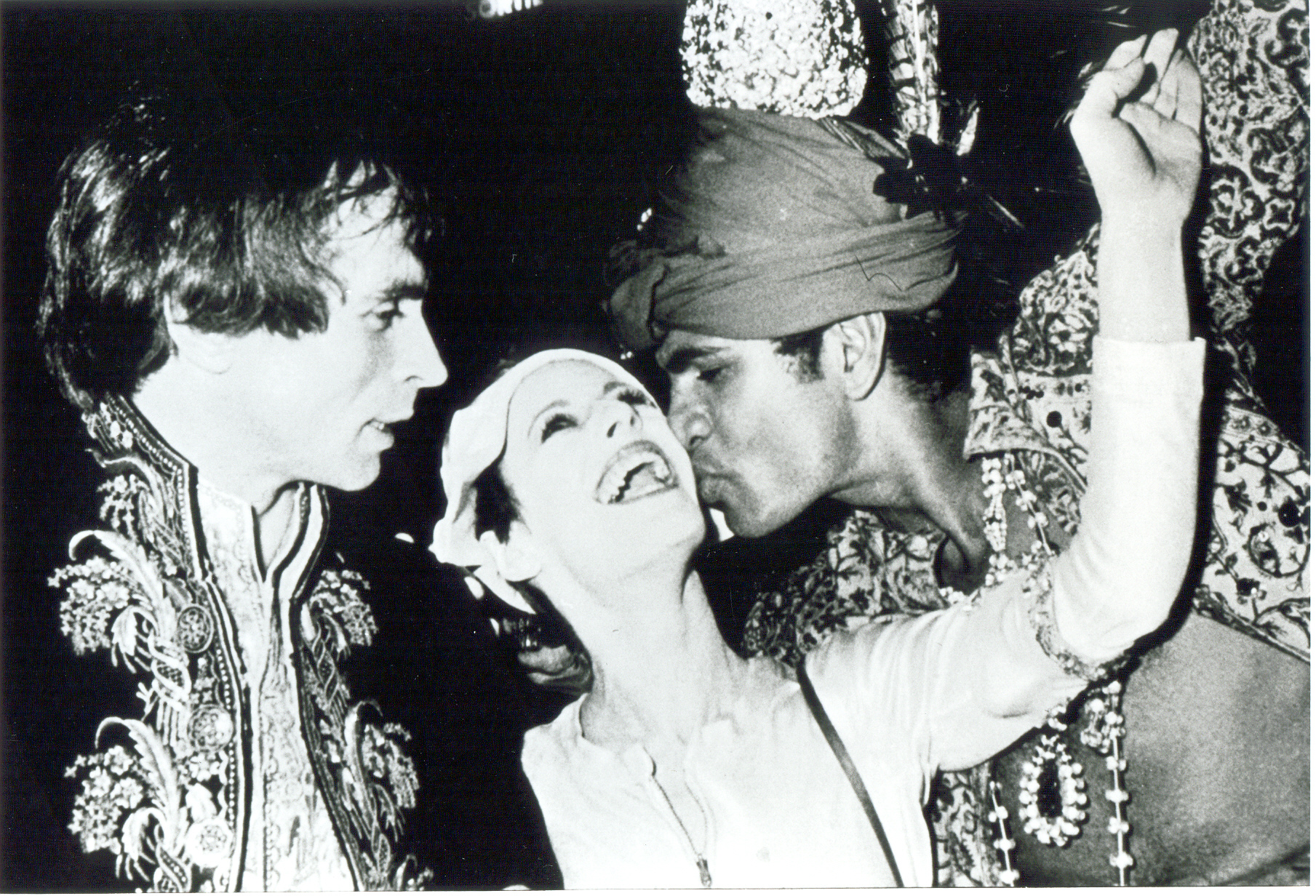
The Russian Years: Lilac from the Gods
The Defection: No Running, No Jumping
Erik Bruhn: The Burn of Ice
Nureyev and Fonteyn: A Taming of Sorts
The Seventies: Gate Crashing
The Paris Opéra Years: Baggage of Knowledge